Showing posts with label mama crafts. Show all posts

Thursday, April 28, 2011

Fleece Flower Pillows


  SUPPLIES:
Fleece (1/2 yard in the color of your flower, plus some coordinating scraps for the center and leaves) You could also use felt, but I think fleece is softer!
Scissors
Hot Glue Gun

DIRECTIONS:
1. Cut two circles out of your fleece. The size is up to you. I traced a large bowl and my circles were about 14". Sew (or hot glue) around the edges, leaving an opening for stuffing. Next, using a piece of chalk or marking pen, trace a smaller circle for the center of your flower and three additional rings to make a bullseye design.

2. Cut out four leaf shapes. I just eyeballed them. Then sew the leaves together along the outside edges and add stitched leaf veins. (You could also just hot glue the edges and draw the veins on with fabric paint or markers.)

3. Add stuffing to your pillow and stitch (or glue) closed the opening. I then used pinking shears to trim the edges of the pillow and leaves to make it a little more decorative (optional).

4. Using hot glue, attach the leaves to the edge of your pillow. The edges are "pinked" and the leaves are attached.

5. Cut out a bunch of petals. Again, I just eyeballed a petal-like shape. You could make them wider/narrower/more rounded/more pointed, etc. depending on what you want your flower to look like. I made them in two sizes, a larger one for the outer petals, a smaller one for closer to the center. I actually cut out and used a lot more, probably 50-60 or so.

6. Starting on the outer ring of the bullseye you traced, start gluing down your petals. I found it worked best to put a line of glue along the bottom of the petal, pinching the center to give it a little dimension, then attaching it.

7. Once the outer row is complete, start working on the next ring of petals. I added an additional drop of hot glue to each petal to help hold it down and cover the line where the first ring of petals were attached. Use an additional drop of glue on the inner rings of petals.

8. Keep adding petals until your flower is complete. I used the larger petals for the outer two rows, a mix of large and small for the next row, and all small petals for the inner row.

9. Cut out some circles to create the center of your flower. (I used pinking sheers again). For each circle, add a bit of hot glue to the center and squish it to form a little ruffle-y shape and attach them to the center of your flower to fill it in.

Source: http://cometogetherkids.blogspot.com/p/ideas.html

Wednesday, March 2, 2011

Homemade Wall Stickers

http://brandyscrafts.blogspot.com/2010/05/contact-paper-cardstock-wall-decals.html

I am lovin' this idea for DIY vinyl wall stickers! Definitely on the to do list for my basement and maybe the girl' rooms, too!

Saturday, June 26, 2010

Dollar Store Cake Stands


SOURCE: http://www.joyshope.com/2010/06/carnival-of-tiered-trays.html
But first you need to head to Dollar Tree and pick up:

One tube of Super Glue Fix-All Adhesive,

three silver-esque trays,

two crystal-esque candlesticks,

per tiered tray that you plan to make.

Be warned.

You will want to make many more than just one.

Many, many, more.

On your way home stop by your fave hardware or craft store to get

spray paint,

spray primer &

a mask.

This is stinky business.

Also get a canvas tarp if you don't have one.


First spray the front and back of each tray and candlestick with primer.

Sort of an annoying step, but so very worth it, considering how shiny and smooth they are.

This will help the color stick and stay on through what is sure to be many a use.

Then start your rainbow party.

Two to three light coats is the way to go.

Be patient. Spray paint dries fast, but drips and goops if you get all crazy and lay it on too heavy.

Spray the bottoms of the trays too, since you will be able to see them, if even just a little.

Run a bead of glue along the bottom of each candlestick and then press it to the center of the bottom of two of the trays.

Let dry.

By using the candlesticks upside down, you get more useable area on your trays.


When the glue is dry, flip it over and attach the third tray on top.

Again, let dry with added weight for better adhesion.

When this tier is dry, add the other tray and candlestick beneath it.

Let dry.

{Keep in mind that these trays are NOT food safe or dishwasher safe.}

Reversible Sun Top


SOURCE: http://www.u-createcrafts.com/2010/06/reversible-sun-top-tutorial-by-from.html


Use 1/4 inch seam allowance unless otherwise noted.


What you will need:

- Aprox 1/2 yard each of two different fabrics

- 1/2 inch elastic

- Sewing machine, thread, and all that stuff

Your Pieces:

When you are done cutting you will have 6 pieces.

2 shirt panels

4 Strap Pieces


To cut these you need to take a couple of measurements from your kiddo.

1. Measure all the way around your child's chest (We'll call this measurement A)

2. Measure mid chest, up over the shoulder to the same spot on the back- This is for the strap length.

(We'll call this measurement B) Be conservative on the measuring so the straps don't end up too long.

3. Measure mid chest down to where you want your top to end. (We'll call this measurement C)


Shirt Panels (cut 1 of each fabric)

Measurement A multiplied by 1.5 + 1 inch

For example my measurement A was 23 inches X 1.5 + 1 inch = 35.5 inches

Now take Measurement C and add 1/2 inch

For example my measurement C was 13 inches + 1/2 inch = 13.5 inches

I am going to cut two panels (one of each fabric) 35.5 inches by 13.5 inches

Straps (Cut 2 of each fabric for a total of 4)

Measurement B multiplied by 1.5 + 1/2 inch by 1.75 inches (all sizes)

For example my Measurement B was 10 inches X 1.5 + 1/2 inch = 15.5 inches .

I am going to cut 4 pieces (2 of each fabric) 15.5 inches by 1.75 inches

Let's get sewing! Take one strap piece of each fabric (so you will have two strap pieces which are different). Right sides together sew down the long edges leaving the ends open. Do this with the other two pieces.

Turn your straps and press. Top stitch in from either side 1/4 inch. This is going to be the casing for your elastic.

Cut two pieces of elastic the length of your measurement B + 1/2 inch. So I cut two pieces of elastic 10.5 inches. using a safety pin insert into the casing of each strap. Sew the very ends just to secure the elastic. Even out the fabric along the elastic to create nice pretty gathers. Set straps aside.

Grab one of your shirt panel pieces and fold right sides together sewing down the short end. You will create a tube like shown. Now opposite your seam sew along the fold 1/4 inch. I like side seams on things. If it doesn't bother you just having one seam you can skip this step. Do the same thing with the other shirt panel.

Take one of your shirt "tubes" and using a ruler mark into thirds. Pin your straps to the two marks you made. Your opposite fabric should be facing up.

Take the other end of your straps and pull under your shirt panel and up to the same spot on the other side. Pin.

Place inside your other shirt panel, right sides together matching side seams. It is a good idea to pin all the way around. I'm going to be a rebel and not pin. I like to take risks like that. Sew all the way around and remove pins.

Turn right side out and press. This is what you should have so far.

Top stitch along the top edge 1/2 inch in. Then in again a little more than 1/2 inch to create a casing for your elastic. The second line of sewing you do make sure you leave an opening of about an inch to insert your elastic. To create an even line of stitching I just place my elastic on top lined up to my first row of stitching to make sure I am going to have a wide enough casing. I am just using the elastic as a ruler, not sewing it!

Cut a length of elastic equal to measurement A. Putting your hand up between both layers of your top insert your elastic. Sew ends of elastic together and then close up the inch you left open to insert the elastic. This is what you will have now. Almost done!

Press up your shirt panels 1/4 inch. I am showing you one panel. Do this with both.

Top stitch the bottom hem in about 1/8 inch. Your hem should be completely even on both sides and the top stitching should show through on the other side on the same spot. This will enclose the raw edge of the bottom of your top. You're done!

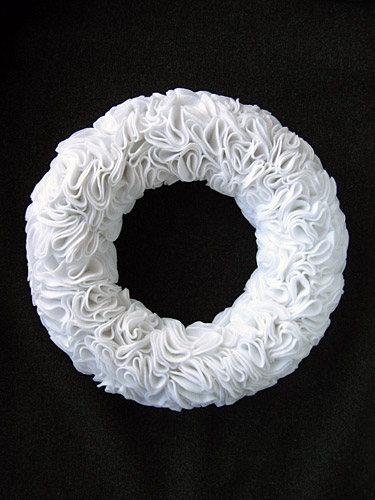
Ruffle Felt Rosette Wreath


SOURCE:  http://www.domestifluff.com/2009/11/how-to-make-a-ruffly-felt-rosette-wreath/

What you’ll need for the wreath:
- a 12 inch styrofoam wreath form
- approximately 2 1/2 yards of felt
- straight pins (enough to match the number of felt circles needed, plus two for attaching the hanger)
- scissors
- a 3 inch circle template
- a pencil
- ribbon for hanging


Using a pencil and your circle template (or that great tutorial from maya*made), trace circles onto the felt. Cut the felt circles, and fold them in half twice to form rosettes. Insert a pin near the bottom corner of the rosette, about 1/8 inch from the corner.

Attach the felt rosettes to the wreath form, making sure to group the rosettes tightly enough that no styrofoam is showing through the rosettes. After you’ve added a few, fluff and adjust the rosettes to your liking. Continue making, pinning, and attaching the rosettes until you’ve worked your way around the wreath form. If you have circles that are slightly misshapen or that have a little pencil or ink on them, place them toward the outside or inside edges, where they can’t be seen when the wreath is hanging.

This is what my wreath looked like on the back when I was finished. As you can see, I started off with ball point straight pins, but I switched to flat head pins when the rosette count started to get up there and I had to run out and buy more pins. If you use flat head pins, then I suggest using a thimble to push them into the wreath form, or your thumb will take a beating. Ask me how I know.

After you’ve finished adding the felt rosettes, cut a 5 inch length of ribbon, fold it in half, and attach it to the wreath form with two pins to form a hanger.

Hooded Towel Bathing Suit Cover Up


SOURCE: http://crafterhours.blogspot.com/2010/06/beach-towel-dresses-tutorial-ish.html


No real tutorial for these, as they were stunningly easy to make, but here is a run down to show you what I did.
These are the pieces you'll need. The red lines that I drew indicate where you want to use the finished edges of the towel to save yourself some work.
First, ruffle the trim and sew it to the bottom of the dress pieces. Sew the two hood pieces together.

Then sew the dress together on the side seams and shoulder seams. Sew the hood to the neckline. Finish the arm holes and neckline with bias binding. When you sew the bias binding around the neck, make sure you catch the hood's seam allowances also.
That's it!

Ruffle Flower Onesie


SOURCE: http://mintnclandycreate.blogspot.com/2010/04/flower-ruffle-onsie.html


Materials:

Scissors
Ruler/Measuring Tape
Lighter/Candle
Bowl of water
Synthetic Fabric
Beads or buttons
Fabric paint with small tip (or q-tip)
Cordinating Thread
Onesie


Directions:

1. Begin by cutting various sizes of circles out of your synthetic fabric. You'll want Large, medium and small circles.

2. Light your candle, or grab your lighter. Make sure your bowl of water is nearby. Hold the circle of fabric just outside the flame, so that the fabric is melted slightly around the edges. Approach this as you would if you were roasting marshmallows & BE CAREFUL! You don't actually want to catch the fabric on fire. Using a synthetic material is also important - natural fibers won't singe.
3. Once your petals have all been prepared, arrange concentric circles. I used 1 large, 3 mediums & 3 smalls for the corsage on the front of the onesie and several large & smalls for the bottom ruffle. You can play with the arrangements. Some fabrics look better with more layers. For the corsage ruffles, this is the point where you would place your bead on top, and sew through the bead with your thread doubled. Knot it on the back of the flower and repeat until the bead is securely fastened.
4. Secure the flowers to the front of your onesie by hand following the same technique as above - through the bead. After all flowers are in place, sew through all layers from the wrong side of your onesie out through the flower layers to create anchor points to keep flower from wrinkling up after washing.

Step back & admire your handiwork! Your front is finished.
5. Measure up 3 inches from the edge of the leg on the onesie. Arrange your flowers in a straight line and across the onesie and pin in place. I chose to use only large and small petals at this point. Gradually move them through your machine, being careful to pull the pins out before sewing & make sure the petals are laying flat as you continue sewing in a straight line. Backstitch at the beginning and end of your line of flowers to secure them in place. (You could hand sew these if you are uncomfortable with a machine. Just be sure to secure your flowers in place). The sizes of the flowers can vary some, so don't worry if your circles are imperfect. These imperfections give it more personality. I used 7 flowers across the length of the onesie.
6. Using fabric paint, dob the center of each flower to bring them to life. I chose not to use beads on the back, to make it more comfortable & practical for little ones to wear.

Hair Bow Holder

SOURCE: http://mommymeatloaf.blogspot.com/2010/02/little-girl-hairbow-holder.html


After making all the hairbows for my daughter during the blizzard, I decided I better find somewhere to keep them. I wanted to keep them so that I could easily tell what bows she had, but I also wanted it to be cute. I decided to make this cute little face; its just like one I had as a kid.


So, I took a piece of cardboard, traced a bowl to make a circle, and cut it out. I covered the circle with stuffing (because I was out of batting). I then took an old pillowcase and covered the circle, flipped it over, and hot-glued it to the cardboard. I glued a piece of ribbon on the back to hang it from.

To make the hair, I took yarn and made 3 sections with 10 pieces each. I tied them at the end and then braided them together (to keep it tight, I actually tied it to the cabinet while braiding). I then glued the braid around the face and added some bangs.

To make the face, I cut eyes and a mouth out of felt and glued them on.

Pop-Up Puppets


SOURCE: http://mommymeatloaf.blogspot.com/2010/03/peek-boo-puppets.html

Start off with a wooden dowel. Take a styrofoam ball and stick it on the end of the dowel to form a head (I guess it would really be the skull since it will be covered, but anyway...) Then, take a plastic cup, cut out the bottom, and slide it up onto the stick.


Next, take a sock (I used an old one because its cheaper than buying one) and slide it over the ball, down the dowel, and up over the cup. The sock needs to be hot-glued to the cup. Before you glue it, make sure the cup is all the way at the end of the dowel; this is so you have room to move the puppet up and down when its finished. If the sock is longer than the cup, just cut the sock.

Now you want to take fabric, felt, or whatever and cover the cup.

Ok, so on to the fun part. You can use felt cut-outs, wiggly eyes, pom-poms, pipe cleaners,or whatever else you want to make a face and decorate your puppet. This is a part thats fun for the kids. Now of coarse, they can't use the hot glue gun, but you can give them Elmer's and let them go crazy. The Elmer's doesn't stick so well, but when they aren't looking you can use your hot glue gun and re-secure their pieces. For mine, I made curly hair by wrapping yarn around a dowel, wetting it, and microwaving until dry. Make sure to microwave at small increments (20 seconds or so) or you will burn the dowel and yarn. Trust me, I know!!

Thursday, May 13, 2010

Prayer Wall Canvas


Source: http://www.inspiremecrafts.com/inspireme_crafts/gifts/page/3/

The saying goes:

"Matthew, Mark, Luke and John.
Bless the bed that I lie on.
Four corner to my bed,
Four angels 'round my head.
One to watch and one to pray,
And two to guide me through the day."


MATERIALS:

Canvas
Paint
Foam paint brush
Cricut cut letters or stickers
Ribbon
Embellishments
Glue
Scissors

HOW-TO:

1. Start by painting your canvas. I started with a light blue, then added some depth with a little green and darker blue. I just blended them here and there until I found a combo that worked for me.
2. Cut out letters with Cricut machine or use stickers. I measured the canvas and counted out the letters in each line to make sure I chose the right size letters to use.
3. Lay out the letters on the canvas. Start gluing once they are in place. I used the Martha Stewart Extra Fine glue pen. It worked great.
4. Add any embellishments you would like. I cut out a cross and glued a brown bead to the center and then glued to the corner
5. Glue (I used glue gun) the ribbon around the canvas.
6. Cut two strips of ribbon to your desired length to use to hang. Its always better to go long and then cut them. Glue to the back of the canvas. Then bring the two pieces of ribbon together to tie a bow. Cut any excess ribbon off.

Photo Cube Puzzle


Source: http://www.inspiremecrafts.com/inspireme_crafts/fathers_day/

Its an easy project, however, be prepared to give it some time. I'm going to give you the detailed how-to for the actual puzzle, not the box. However, don't forget to give those puzzle solvers a little help by providing pictures of the different puzzles on the front. :)


This puzzle measures 6 x 6 inches. Each block I chose was 1.5 inches on each side. The blocks come in various sizes and you, of course, can essentially choose your own size and number of blocks for your puzzle. I'll give you the materials for the size of puzzle I chose to do.

MATERIALS:
16 - 1.5 inch wooden blocks
Black craft paint
Mod Podge
Sponge brush
Spray Adhesive
Ruler
Scissors
Up to 6 pictures printed on your computer


HOW-TO:
1. Paint all 16 blocks black, on all 6 sides. Let dry.
2. Choose your pictures that you will use for your project. Re-size them to 6 X 6 in. Print your pictures and let them completely dry. Cut the pictures out along the edges. TIPS: When choosing your pictures, try to choose close-ups or ones that won't be too hard to solve. Once you print it out, imagine where it would be cut into squares and make sure their are distinguishing marks that will allow your solver to put the clues together.
3. Turn your picture over. On the back, using your ruler, start to mark the measurements of where you are going to cut. Put a mark every 1.5 inches along the top and bottom, and then every 1.5 inches along each side. Connect the dots using a straight edge to give you your grid. Use a scrapbook paper cutter or scissors to cut along the lines. TIP: I wanted to see the finished puzzle and wanted to apply them in order so I put a number from 1-16 in each box on the grid on the back of the paper to help me keep them in order when applying in case they got mixed up. Repeat with all other pictures. I chose to only do 4 pictures and one note with stickers that read "I luv nana and papa" and then left the last side black.
4. Using your spray adhesive start to apply each picture square to the wooden block. Do all 16 squares of the picture. After you finish one picture move on to the next. Complete all 6 sides. Then allow to completely dry and adhere so no bubbles will pop up when you mod podge. Read your spray adhesives directions to find the time.
5. Next, using your sponge brush, mod podge over each photo square. Be careful to not have the blocks touching when you are having them dry so that they don't stick. Again, do all 16 of one side, let dry, and do another side. You most likely will have to do at least 2-3 coats of mod podge. This is the time consuming part!
6. You're done! While your blocks are drying you can work on your box.

Wednesday, May 12, 2010

I *HEART* You Blocks


Source: http://www.inspiremecrafts.com/inspireme_crafts/fathers_day/

MATERIALS:

1 wood block ( I chose a 4x4 inch)
4 photos (need the letters you want to take the photos). I had photos printed at store for top quality.
Mod Podge or your favorite decoupage
Black paint
2-4 Foam brushes
Scissors

HOW-TO:
1. Paint your wood block black (or your chosen accent color) on all sides. Let dry
2. Cut your pictures to size.
3. Apply thin coat of Mod Podge to back of picture. Adhere to wood block. Smooth out bubbles by using a cloth over the picture. Repeat on each side. Let dry according to directions on decoupage. Usually 20 minutes.
4. Apply coat of Mod Podge over the top of picture and block. You may have to do a couple of pictures at a time, let dry and then do the others. Make sure to get the corners and sides of the pictures as well.
Note: It helps to rest the block on a cup upside down or something similar so the Mod Podge doesn't adhere to the newspaper you may have underneath for dripping.
5. Let dry overnight.
6. Give to a loved one. J

Mother's Day Puzzle

Source: http://www.inspiremecrafts.com/inspireme_crafts/dollar_diva/page/2/


MATERIALS

Scrapbook puzzle or regular puzzle
Paper
Pictures
Glue
Scissors
Ribbon
Hole Punch
Brad

HOW-TO

1. Print out photos to size.
2. Trace puzzle pieces onto various photos.
3. Cut out photos.
4. Adhere photo to puzzle piece.
5. Decorate front 'page'.
6. Punch hole in approximately the same spot on every puzzle piece.
7. Stick brad through all the pieces. Close brad on back.
8. Voila! An adorable photo puzzle collage for mother's day.

Tulle Ruffly Skirt


Source: http://pinkpicketfence.typepad.com/pink_picket_fence/2009/04/her-tulle-skirt-the-new-fave.html

Specifics:

The skirt base: I made this skirt less full than usual -- the tulle makes it full enough. Wait to add the elastic at the end.

The ruffles: The tulle strips are about 2" wide. I think I used a half yard, total.

I attached all the tulle strips together before gathering, so it went quickly. I didn't worry about backstitching or anything.

I made a long stitch (you'll have to experiment) down the middle of the strip and it gathered itself. At first I had it on 'basting' stitch, but it was actually too gathered.

Attaching the ruffles: I started at the top of the skirt. When I got to the end of a row, I overlapped the ruffle a half inch, cut away, backstitched, and then eyeballed the next row and started sewing again. The ruffle really doesn't come undone.

Care: In my experience, you can wash tulle just fine (a lingerie bag works well), just don't put it in the dryer. I wasn't too bright and used linen for the skirt, so I am going to have to iron this one from the inside out, very carefully. Oops. Good thing these are fast in case I have to make a replacement. (Know what would work nicely? A no-iron percale sheet. I'll have to remember that for next time.)

Ruffly Skirt


Source: http://littlebirdiesecrets.blogspot.com/search/label/kids?updated-max=2009-08-12T16%3A05%3A00-07%3A00&max-results=20

Basic Ruffle Instructions

Make this skirt:
http://www.oliverands.com/blog/2008/08/lazy-days-skirt-free-pattern.html

Then, before adding the elastic waist to the skirt, I marked the skirt in 1 ½ inch intervals to help me see where to sew on my ruffles. I then took a contrasting fabric and cut them into 1 ½ inch pieces, selvage to selvage (about 44 inches). You need about two of these pieces per ruffle tier on your skirt. I then used my serger to finish the edges of my ruffles so they won’t fray. If you like the frayed look you may want to skip this step. If you don't have a serger, you can either zig zag or overcast stitch your ruffle pieces with your sewing machine.

Next, using my sewing machine and some tweezers, I scrunched up the ruffles as I sewed them down to the skirt using my marked lines. (This keeps your fingers out from under the needle!) Once the ruffles were on, I added the elastic. I made this skirt a little big for my girl because I want her to be able to wear it longer than a month—kids grow so fast!

Princess Wand


Source: http://littlebirdiesecrets.blogspot.com/search/label/kids?updated-max=2009-08-12T16%3A05%3A00-07%3A00&max-results=20

What you'll need:
*5 or 6 Dowels (we used 12" dowels)
*Hand-held drill
*Wood clothespins
*Cookie sheet and oven
*Assorted ribbons
*Wire
*Extreme Glitter Paint from Plaid

Step One: Drill a small hole in one end of a 12" dowel. With the remaining dowels, use a clothespin to clip one end of ribbon to the end. Tightly wrap the ribbon around the dowel and use another clothespin pin it in place. Wrap all of your dowels with your ribbon.

Step Two: Place on a cookie sheet and bake in your oven for 20 minutes at 275 degrees.

Step Three: While your ribbons are baking, paint the dowel with the hole in it with glitter paint. We like Plaid's Folk Art Extreme Glitter. It's a transparent paint full of fine glitter that gives your project a little sugar. We painted it directly on the wood, but you could also paint your dowel with an acrylic paint and then finish it off with a layer or two of Extreme Glitter on top.

Step Four: Slowly unwrap the ribbon and cut to your desired length. Apply Fray Check or similar product to ribbon ends to prevent fraying. You can also heat set them with a heat gun or a flame (be careful not to burn yourself or start your ribbon on fire though!).

Step Five: Lay the ribbons out evenly and use a clip (I used a large salon clip from the beauty supply store) to hold them all in place. Take another thin piece of ribbon or string and tie all the pieces together. Double knot it.

Step Six: Run a piece of wire through the hole in your painted dowel. Then run the wire under and around the thin ribbon you used to hold the spirals together. Wrap the ends of the wire around the dowel so it will not move. If you want, you can also use glitter spray to spray the ribbons to make it even more dazzling.

Little Chick Tutu Costume


Source: http://littlebirdiesecrets.blogspot.com/search/label/kids?updated-max=2009-11-30T08%3A53%3A00-08%3A00&max-results=20

Little Chick Tutu Costume


Supplies:

*One or two rolls of 6" wide yellow, white, or blue tulle, depending on what kind of bird you want to make (found in the wedding section at your local craft store)
*Feathers to match your tulle
*Hair clip
*No-roll elastic
*Hot glue gun and glue
*Sewing machine and thread

Okay, let's get started!

1. First, measure your child's waist. Subtract one inch from that number and cut your elastic that length. For example, if my child's waist is 12 inches, then I would cut an 11 inch piece of elastic. Sew the elastic together at the short ends so you have a ring like below.

2. Next, cut your tulle. I used two whole rolls for a toddler sized tutu and only one for a baby (10 month old) size. Measure the length from the waist to where you want your tutu to stop. Double that number and that is how many inches you will need to cut your tulle. For example, I wanted the tutu to be 15 inches long for my toddler daughter so I cut 30 inch pieces. When I made the baby tutu, I only wanted it 8 inches long so I cut the tulle 16 inches long.

3. The easiest way to make the tutu is to put the elastic on your leg like a garter. Then start tying your tulle around the elastic. Make sure you double knot the tulle. Continue tying the tulle around the elastic until you are happy with how full it looks.

4. Now, get out your hot glue gun. Very carefully place hot glue on the double knots of your tulle. This is where you will stick your feathers. You will need to be patient and go slow.

5. Once you have a dot of hot glue on the knot, carefully place your feather on it. You may need to trim the tips of your feathers. A lot of the feathers I used had sharp pointy tips. I just snipped them off before sticking it to the hot glue.

6. When you are done your tutu will look like this. Next, hot glue some feathers to your metal hair clip or hairband and you have half the costume done. Find a matching onesie or shirt and add some orange leggings. Ta-dah! One little chickadee or blue bird or swan or whatever suits your fancy.

Old Board Book into Personalized Baby Book

Source: http://katiesnestingspot.blogspot.com/2009/01/altered-baby-board-book.html


The first things I do is make sure the binding is intact. You don't want to put a lot of hard work into your creation and then have it fall apart after a few uses, trust me this is from experience! Most board book pages have a shiny coating on their pages. I sand the pages using a scrap of sand paper and then wipe off all the little bits. I read somewhere that this gives the glue something to hold onto and ensures better adhesion. Next I plan out my pages, choosing which pictures to include, papers and ribbons, what embellishments to use, etc. A note on embellishments: try to use as many flat embellishments such as stickers and die-cuts if you want your finished book to close and be somewhat flat. All the fancy 3-D embellishments will add to the bulk of your book and prohibit it from closing.


It's all a matter of preference, because I've made some with bulkier embellishments and I think the finished book looks pretty with the pages fanned out on a table. In that case, I display mine standing up, so the front cover looks like a frame.

The pages reveal a little bit of what's inside and I think it makes your guests want to pick it up and look at it. Also, if you are using 3-D embellishments keep them toward the outer edges of your pages, the idea is to have a slight fanning of the pages, not to have them completely open. The design phase is also the time to plan for any extras such as, shortened pages, windows, or flaps. A shortened page is just that, when you cut part off, so that a little of the following page can be seen. A window involves two consecutive pages; you cut a shape out of one page, I found a square to be the easiest one. Place a photo behind the opening and glue to either the back of that page, leave a border around the print for glue, or glue it to the following page so that it can be seen through the opening. Adhere both pages together, I like to use really strong double sided tape to do this as it's quicker, but you can also use mod podge.

You will need to apply the glue, then use clamps or clips to hold the two pages together overnight. A flap page is similar to a window, but when you are cutting out the shape cut out three sides and score the last one so it will open. Glue the first page to the second, being careful to not glue the flap. You can place a picture or patterned paper and embellishments in the opening of a window or flap.

Okay so now you've prepped your book by sanding and wiping it clean, planned out the pages, and made any necessary cuts to pages for extras. To assemble. Cover each page, one at a time with a thin layer of mod podge. Cut decorative paper to slightly larger than the page. Attach and smooth out any wrinkles with your fingers. Continue until pages are all covered. Let glue dry. Cut around each page with an x-acto knife. Sand away any excess paper so edges are smooth. Now you can decorate and embellish to your heart's content.

I save the cover for last, because if bulkier embellishments are used on the front it can make it harder to complete the inside pages if the book will not longer lay flat. If you choose to use flat embellishments on the inside, the front cover is the place to go crazy, I've even attached bigger items with hot glue.

Cover the front and back using the same method as the inside pages. Measure the spine of the book's height and width. Add an inch or so, so that the binding will be covered as well as some of the front and back. Using a coordinating scrap of paper, cut binding cover and hold up to your book to check that you like how it "fits" and make adustmentss as necessary. Cover the binding by, attaching first to the front of the book, folding it and gluing as you go around the spine, and then gluing it to the back.

I like to cover the seams on the front and back with ribbon. Cut to lengh and use glue dots to attach, fray check the ends before attaching. Or attach with mod podge, I haven't needed to fray check the ends as the glue does that for you. When you are finished you may want to apply a thin layer of mod podge to the covers to protect it from fingerprints and smudges.

If you embellish the front with silk flowers or something along those lines do not put mod podge on top of those. In that case, apply mod podge on the unembellished cover, let dry, and then hot glue on bigger items. I usually also apply a thin layer onto of each inner page, allow for drying time. You can apply mod podge right over any embellishments and photos as it drys clear.

Magnet Bookmarks


Source: http://www.inspiremecrafts.com/inspireme_crafts/2009/06/gotta-make-it-magnet-bookmark.html

This project takes 5 minutes, so squeeze a little time in and whip-up some eye candy for your summer reads.


What You Will Need:

Paper (photo, card, ticket, postcard, etc)
Adhesive Magnets
Scissors
1. Fold your paper in 1/2. You can use any size you want.
2. Cut your magnets to size if needed. Remove the adhesive protector from your magnets. Place one magnet on each end of your paper so that when you fold it they attract.
3. Start using the magnet bookmark in your book